by Sally Sedgwick
When Great River Energy’s engineering group looks at local transmission lines feeding its 26 rural electric cooperatives, it rates the line looking at a number of maintenance points: age, cost to repair vs. replace, number of bad poles, access and more.
A few years ago, the main Highway 6 transmission feed to North Itasca Electric rose to the top of the list. The 69kV line originally was constructed in the 1950s and still has some original poles. The older wire has a smaller diameter, and the existing line does not have lightning protection. A large part of the line followed an old railroad bed through a wetland area. That track has been taken up, and access to it during the summer is very difficult.
In addition, it is the main feed to the North Itasca Electric system, and it has experienced an outage in recent years.
Three years ago, the project to replace the 19 miles of line between the Deer River and Jessie Lake Substations began with open houses. Obtaining easements was an important part of the project as about 10 miles of line would be rerouted from the old railroad bed to an accessible 100 ft. right of way along Highway 6, explained Dale Aukee, senior field representative for land rights.
Easement acquisition was well received. Landowners and the Leech Lake Band of Ojibwe have been good to work with; they understood the need and purpose of the reroute, Aukee said. Part of the change will remove the line from wetlands, which was seen by the Band as positive.
The reroute has required tree removal on the right of way; those trees remain property of the landowner if wanted, or GRE contractors will remove and/or grind on site if preferred.
Construction began in January 2025, and GRE hopes to complete the project this fall, but federal permitting issues still need to be resolved. About 10% of the route still needs the final approval, Aukee estimated, as a short amount of federal land was part of the larger Department of Natural Resources application, which has been approved. If the delay extends to warmer weather, the project may have to be put on hold as some permits require frozen conditions.
The line begins as a double circuit in Deer River and then breaks into two; one portion coming north to Jessie Lake and the other going west to Ball Club and Bena. The single circuit coming north uses brown wood poles, about 70 feet high placed 300 to 350 feet apart. Where they are required due to a change in wire direction, there are some steel poles or rectangular laminated wood poles, the latter able to be installed without guy wires. The top wire is designed as lightning protection, able to diffuse the charge of a strike.
Crews working to place the new poles use large interlocking fiberglass matts that spread the weight of equipment and give the least disruption to soil and plants, Aukee explained.
The line passes into service territory of North Itasca Electric at County Rd. 172 on its way to the Jessie Lake substation. What is the cooperative’s view of the project? “We’re excited,” said Line Superintendent Daryl Pederson. It’s a brand-new line and a route that will make any restoration in an outage quicker, he said.
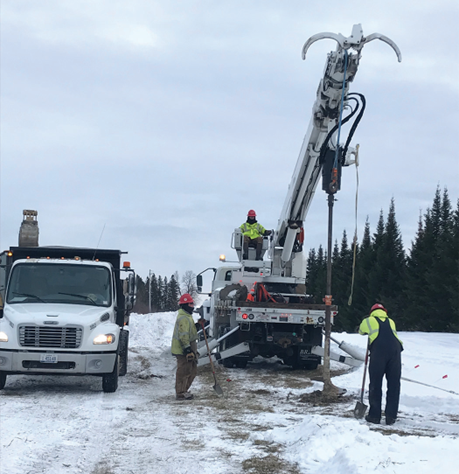
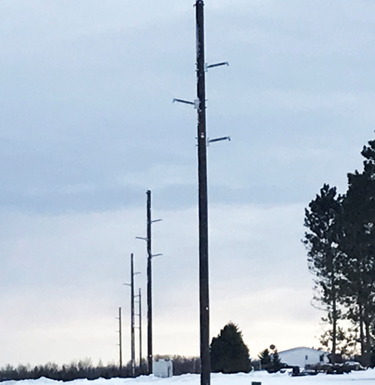
Caption: (l) Contracted crew from Brinks drills a hole 13 ft. deep to set a pole, (r) Poles near Oteneagen Rd. along Highway 6.
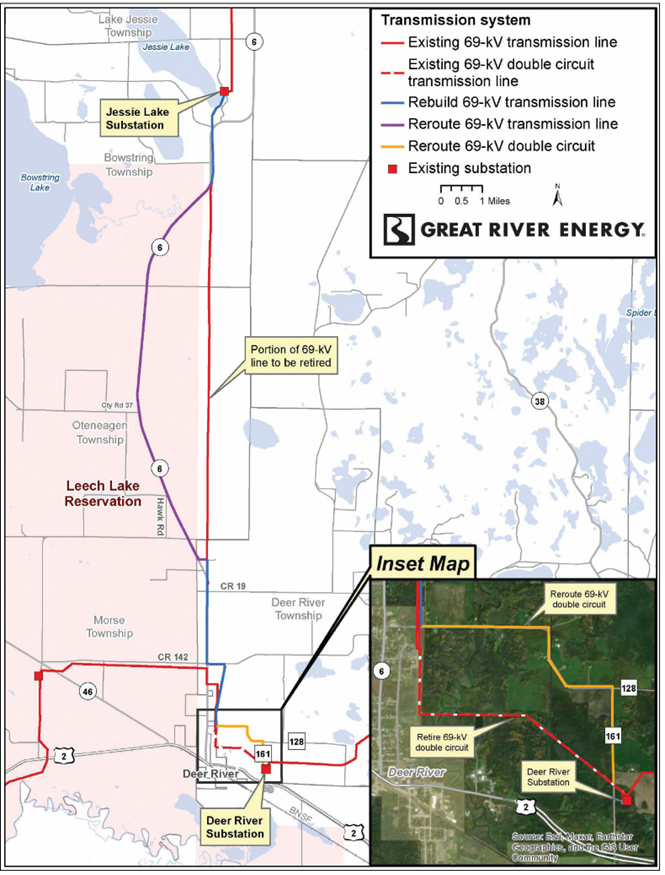
Map courtesy of Great River Energy.