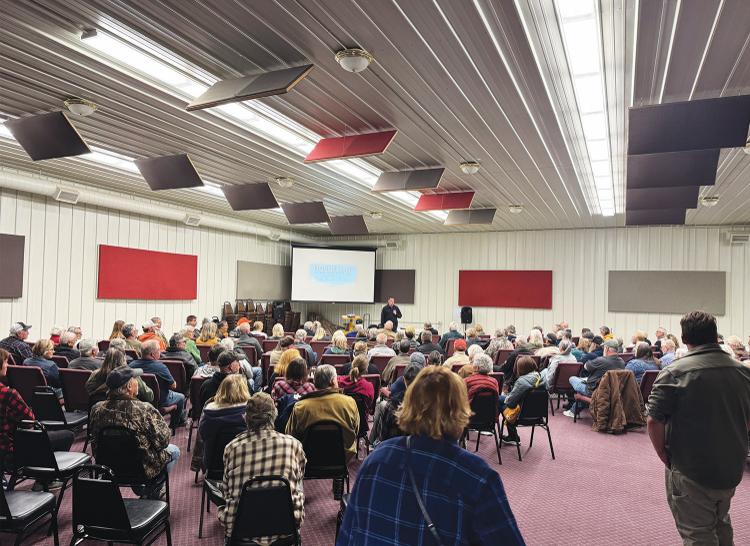
About 170 gathered at the Marcell Family Center on Oct 14 to hear from industry experts on data centers – what they are, and how they could impact the community.
by Sally Sedgwick
You might think of it as cloud storage – up in the air. But in reality it is very down to earth, storing everything digital, from cryptocurrency payments or health medical records to your children’s photos and Facebook posts inside what are called data centers.
Data centers can be different sizes and serve different uses: they can be dedicated to one company only, limiting access to others, or they can service a number of companies colocated in shared space.
And they can be different physical sizes, from a small center using less than one megawatt to an AI (artificial intelligence) hyperscale center that may use over 1,000 MW. Currently there are none of these large centers in Minnesota, although several are proposed, said Tiffany Kovaleski, founder of GOR (Grit Over Resume), a data center workforce development company.
She was speaking to a large crowd of about 170 at the Marcell Family Center in a discussion hosted by North Itasca Electric Co-op to answer questions that CEO Brad Dolinski had heard from community members. Kirk Stevens from Steadfast Operations, a contractor that sets up data center facility design and operations procedures and policies, joined her to answer technical questions.
There have not been any inquiries about placing a data center on the co-op system to date, Dolinski said, but it is an actively growing industry, and he believes that co-op members should have access to accurate information about the facilities.
There are reasons that a small electric cooperative would be a natural venue for such a meeting. Dolinski spoke of the financial issues that come with upward pressure on rates following policy decisions that encourage building transmission lines across Minnesota. Those costs fall to Great River Energy and subsequently to its owner cooperatives. About half of the consumer bill for North Itasca Electric members is wholesale electricity costs from GRE. If those rates increase, there are just two places the co-op can turn to: the members or growing the load base.
Data centers use electricity, lots of electricity. Currently the North Itasca Electric system peaks at about 15 MW. If the load increased by one MW, it would produce about $657,000 additional net income for the co-op, Dolinski estimated. That money would ease the pressure on rates: rates that are needed to maintain the lines, buy the trucks and safety equipment, and bury lines.
How much power could a rural co-op like North Itasca Electric actually access? GRE estimated it could draw an additional 30 MW, and Kovaleski suggested a likely size for a data center might be about 24MW. That size center would also create an estimated 25 to 50 permanent direct jobs, and Stevens estimated it would be about 40,000 square feet or about an acre in size.
Kovaleski was not there to support or criticize data centers, she said, but as a volunteer both from the industry and as a parent and community member to explain what data centers are, how they impact communities and questions that should be considered.
There are currently 43 data centers in the state that range from 3 to 20 MW, she said. Large corporations account for 23 of those, where a typical one could be the size of the Marcell Family Center. There are also 20 colocated “NFL city” facilities – “NFL” referring to the urban locations where they can be found – which range from 3 to over 10 MW.
All are connected with fiber, and connectivity is one of the words of industry jargon she had to know as she entered the industry, along with such terms as “modular,” “latency,” “block chain” and “computer nodes.” Connectivity is also one of the requisites looked for by data center companies wanting to find a site, whether they are considering retrofitting an existing building – “brownfield” or new construction -“greenfield.” Other requisites are available land, a supportive community, water, construction services and workforce.
Some of these become more important when communities are knowledgeable about data centers and negotiate with the incoming business, Kovaleski said. For instance, a small community welcoming a large data center can negotiate for support of local infrastructure, funding for local foundations, structural requirements to protect the environment, or even use of local tradesmen.
There were a number of questions about water use and possible contamination of the water table. Water is important for cooling, and can be used in closed or open loop systems. Open loop systems are a pass-through where warm water is discharged through a cooling tower or as warm effluent into ponds or rivers. Closed loop systems use a 25 to 40% glycol mixture and are cleaned and refilled on a 10 to 25 year cycle, according to Stevens, with the old liquid pumped into trucks for disposal in a designated place.
An audience member was concerned about water use and the current drought, saying that three years of above average rainfall was said to be needed to restore the water table. Itasca County Commissioner Casey Venema pointed out that there were locations on the east Range where there was excess rising water in the pits and consequent flood danger to adjacent cities. Here a water user might be welcome, coupled with power provided by large transmission lines coming from Canada.
A built in failure containment system could be a negotiating point, said Kovaleski. Data centers also have banks of generators and 12-24 hours of fuel in case of outage. Liquids like fuel and cooling water can be located within a containment area to prevent contamination in case of leaks.
Another question that communities should ask is what happens if a data center were to be abandoned, said Kovaleski. Generally a greenfield site should be restored to its original condition with the building removed.
Transparency was also an issue for the audience. When would the public know about a possible data center and what chance for input would they have? Stevens said that in his experience across the country, all locations were different. It just depended on how the local town wanted to handle it.
At the state level, Representatives Spencer Igo and Roger Skraba noted that data centers were on the agenda for the legislature, with a “roadmap” for larger data centers (an investment of $250 million or more) being passed in a special session last summer. Igo also cautioned that people be careful to source information found on the internet to be sure it is legitimate and not from foreign sources seeking to influence people.
Several members of the audience expressed their appreciation for the presenters and the meeting. “We need to keep the conversation going,” said Dolinski.
For community members, Kovaleski suggested resources found on the website of AFCOM, afcom.com, an association of data center professionals where she chairs the Greater Minnesota chapter. Research, news articles and white papers can be accessed for more information